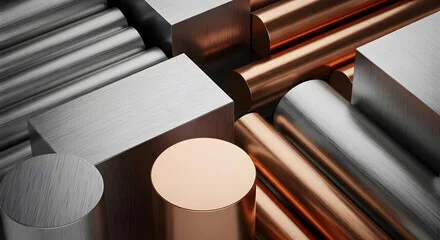
As processors continue to deliver more computing power in increasingly compact form factors, thermal management has become one of the most important design considerations in embedded systems. Whether it’s an AI-enabled VPX module, an edge computing platform, or a rugged mission computer operating in harsh environments, effectively transferring heat away from critical components is essential for maintaining reliability and long-term performance.
One of the most fundamental decisions in thermal design is the material used for the heat plate. Copper and aluminum are the two most common choices, each bringing a unique combination of thermal, mechanical, and manufacturing characteristics.
Rather than asking which material is better, the more useful question is: Which material best fits the application’s requirements?
Why Heat Plates Matter
Heat plates serve as the primary thermal pathway between heat-generating components—such as CPUs, GPUs, FPGAs, and power electronics—and the cooling solution. In conduction-cooled systems, they transfer heat directly into the chassis. In air- or liquid-cooled designs, they spread heat efficiently toward heatsinks or cold plates.
For rugged embedded systems, selecting the appropriate material affects more than thermal performance. It can influence:
- Weight
- Mechanical strength
- Manufacturability
- Cost
- System size and packaging
- Long-term reliability
At WOLF, thermal management is considered alongside mechanical, electrical, and environmental requirements to ensure products deliver reliable performance in demanding operating environments.
Copper Heat Plates
Copper has long been regarded as one of the highest-performing engineering materials for heat transfer. With a thermal conductivity of approximately 390–400 W/m·K, copper can reduce spreading resistance and temperature gradients around localized hot spots, making it well suited for applications with extremely high heat densities.
Advantages
Excellent Thermal Conductivity
Copper’s greatest advantage is its ability to conduct heat efficiently. When components generate significant localized heat—such as modern GPUs or high-performance FPGAs—copper can distribute that heat rapidly, helping reduce temperature gradients across the heat plate.
Better Temperature Uniformity
Because heat spreads quickly throughout the material, copper often provides more uniform temperatures across the cooling surface. This can be particularly valuable when multiple components share the same thermal path or when minimizing hot spots is critical.
Well Suited for High Heat Flux Applications
Applications involving dense AI processing, sensor fusion, or advanced graphics frequently generate substantial heat within a limited area. Copper’s conductivity helps manage these concentrated thermal loads more effectively.
Considerations
Despite its thermal advantages, copper also introduces several design considerations.
Its density is more than three times that of aluminum, increasing the overall weight of a system. In airborne, mobile, or SWaP-constrained applications, this additional mass may become a significant factor.
Copper is also generally more expensive, both as a raw material and from a machining perspective. Manufacturing complex geometries often requires additional processing, which can increase production costs and lead times.
Aluminum Heat Plates
Aluminum is one of the most widely used materials in thermal management because it offers an excellent balance of thermal performance, weight, manufacturability, and cost. Although its thermal conductivity—typically 150–230 W/m·K, depending on the alloy—is lower than copper’s, it remains more than adequate for many embedded computing applications.
Advantages
Lightweight
One of aluminum’s greatest strengths is its exceptionally low density. Weighing roughly one-third as much as copper, it allows designers to reduce overall system weight without sacrificing structural integrity. This makes aluminum particularly attractive for aerospace, unmanned systems, and portable computing platforms.
Easier Manufacturing
Aluminum machines and extrudes more easily than copper, enabling complex shapes and integrated thermal features while reducing manufacturing time and cost. This flexibility often allows engineers to optimize cooling solutions without significantly increasing production complexity.
Cost-Effective
For many programs, cost is an important design constraint. Aluminum generally provides lower material and manufacturing costs while still delivering strong thermal performance, making it an attractive option across a broad range of embedded applications.
Good Corrosion Resistance
Many aluminum alloys naturally resist corrosion and are commonly anodized for additional environmental protection, an important consideration for systems expected to operate in challenging environments.
Considerations
Because aluminum has lower thermal conductivity than copper, it may require greater thickness or cross-sectional area, shorter heat-spreading distances, or additional thermal design optimization to achieve comparable cooling performance under very high heat loads.
Engineers must therefore consider the complete thermal architecture—including airflow, conduction paths, chassis design, and power density—rather than relying solely on material properties.
The Choice Depends on the Application
Material selection is rarely based on a single property. Instead, engineers typically evaluate the complete set of system requirements, including:
| Design Priority | Copper | Aluminum |
|---|---|---|
| Thermal conductivity | Excellent | Very good |
| Weight | Higher | Lower |
| Cost | Higher | Lower |
| Machinability | More challenging | Easier |
| Heat spreading | Excellent | Good |
| Structural efficiency | Good | Excellent strength-to-weight ratio |
In many modern embedded systems, the optimal solution may combine both materials. Designers sometimes use copper where maximum heat transfer and reduced spreading resistance are required, while using aluminum where lower weight or reduced manufacturing complexity provides greater value.
Hybrid thermal assemblies can leverage the strengths of each material while balancing overall system performance. However, combining copper and aluminum introduces additional engineering considerations, including galvanic corrosion, differences in coefficients of thermal expansion (CTE), thermal resistance at material interfaces, and the joining method used. These factors must be carefully managed to preserve thermal performance, mechanical integrity, and long-term reliability, particularly in rugged environments subject to moisture, vibration, and repeated thermal cycling.
Looking Beyond the Material
While copper and aluminum often receive the most attention, the effectiveness of a heat plate depends on far more than its composition.
Component placement, interface materials, chassis integration, airflow or liquid-cooling strategy, power density, and overall mechanical design all contribute to thermal performance. A well-designed thermal solution considers these factors together rather than optimizing a single material property.
For rugged embedded computing platforms operating in demanding environments, thermal management is ultimately a systems engineering challenge—one that requires balancing performance, weight, manufacturability, reliability, and lifecycle considerations.
Rather than viewing copper and aluminum as competing solutions, they should be seen as two valuable engineering tools. Each offers distinct advantages, and selecting the right material depends on the performance objectives and constraints of the specific application.
About Wolf Advanced Technology
Wolf Advanced Technology (WOLF) delivers rugged, high-performance embedded computing, AI, and video processing solutions for aerospace and defense. Leveraging NVIDIA® GPUs and AMD®/Xilinx® FPGAs, WOLF delivers SWaP-optimized VPX (SOSA® aligned), XMC, MXM/MXC, VNX+, SFF, and custom solutions, enabling real-time video, AI inference, and high-speed data in mission-critical environments.