WOLF-9476
Block Diagram
The block diagram illustrates a rugged chip-down module centered on the RTX A2000 (Ampere) GPU, highlighting the PCIe host interface and the multi-output display routing. It emphasizes the primary data movement path for compute/AI workloads and the thermal/mechanical integration concept where heat is conducted from the GPU die into the module’s conduction path.
Overview
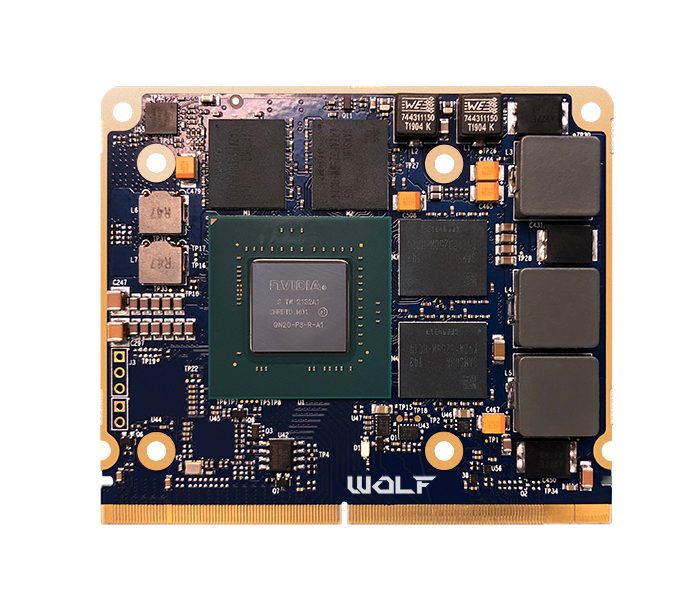
Rugged NVIDIA RTX A2000 Module for Aerospace and Defense
The WMXM-A2000E-VO module uses a WOLF chip-down design to provide NVIDIA’s advanced Ampere architecture GPU technology in an extremely rugged module, making it an excellent choice for aerospace and defense applications. WOLF designs and manufactures these modules in North America with full component traceability.
These modules are designed and manufactured specifically for use in the harsh environments encountered in military and aerospace applications. They have been designed to pass MIL-STD-810 and DO-160 environmental tests. They have been manufactured to IPC-A-610 CLASS 3 and IPC 6012 CLASS 3 for high reliability electronic products. They are compliant with IPC J-STD-001 soldering standards.
The A2000 GPU is an enormous leap in processing power compared to the previous generation Turing and Pascal GPUs. This rugged Ampere-based module can provide up to 8.25 TFLOPS of CUDA processing, providing up to 103 GFLOPS/Watt. It includes four video outputs, which provide support for resolutions of up to 4K at 120Hz with 10-bit color depth. It supports PCIe speeds up to Gen4.
Features
WOLF-9476 is an extremely rugged chip-down MXM module that brings NVIDIA Ampere A2000 GPU capability into aerospace and defense platforms with full North American manufacturing and component traceability. It provides 8 GB GDDR6 memory (128-bit, up to 192 GB/s) and four independent video outputs with configuration options that support DisplayPort, HDMI/DVI, VGA, and LVDS.
GPU Features
- NVIDIA RTX GA107 GPU with 2560 CUDA cores, 80 Tensor cores, and 20 RT cores
- Ampere GPGPU parallel processing support:
- CUDA Toolkit 11, CUDA Compute capability 8.6
- OpenCL 3.0, DirectX 12 Ultimate, OpenGL 4.6, OpenGL ES 3.2, Vulkan 1.2
- 80 Tensor Cores (3rd Gen), 34/66 TOPS (dense/sparse)
- 20 Ray Tracing cores (2nd Gen)
- NVENC (7th Gen) and NVDEC (5th Gen) with up to 8K video encoding and hardware decoding support
- 8 GB GDDR6 memory, 128-bit, 192 GB/s max
Connectivity / System Management
- GPU with PCIe Gen4 x8 interface
- Up to 4 DisplayPort 1.4 digital video outputs
- Up to 4 HDMI/DVI video outputs
- Option for one VGA output
- Option for LVDS LTX and LVDS UTX outputs
- Windows and Linux drivers
- NVIDIA Ampere driver support requires the following host CPU: Intel E, S/H/H35 Class, AMD H/HS Class
Mechanical / Open Systems Architecture
- High level of ruggedization:
- Operating temperature: - 40°C to +85°C
- Vibration (sine wave): 10G peak, 5 - * Shock: 40G peak
- Manufactured in NA, full component traceability
- Component derating meets or exceeds NASA and Rome Labs specifications for reliability
- Increased board rigidity due to thicker PCB material
- Hard gold used on connector card edge (30 µin)
- Additional mounting holes to reduce flexing under vibration and shock
- Standard MXM 3.1 connector compliance maintained
- Conformal coating options available
- Configurable operating power: 26W to 80W
Specifications
Key configuration and performance parameters for WOLF-9476 are summarized below for quick comparison. Values shown reflect the standard module configuration; contact WOLF if you need a tailored build or a specific payload profile.
Configuration Guide
The following table defines a series of common order codes for the WMXM-A2000E-VO module. The asterisks denote characters of the part number that are defined based on common configuration options.
Some configuration options for this module include:
- Conformal coatings
Contact Sales for the latest Ordering Numbers, available options, or MCOTS options.
Representative ordering numbers
| Ordering Number | Description |
|---|---|
| 947631-F000-***MXMvA0 | WMXM Type A, Rugged, Conduction Cooled, NVIDIA RTX A2000, PCIe x8, DP 1.4 outputs 4 |
Related Products
FAQ
Choose WOLF-9476 when you need a rugged, chip-down Ampere GPU module with multi-display output and a strong supply-chain story (North American manufacturing and full component traceability).
This module is typically selected for:
- Platforms that require MIL/aviation environmental robustness and high-reliability manufacturing practices
- Embedded graphics/AI/encode workloads that also need up to four independent display outputs
- Programs that value a stable, ruggedized GPU building block that integrates cleanly onto a carrier
If your requirement is primarily video capture/conversion (SDI/analog ingest), an FGX/FGX2-based MXC is usually the better fit.
Treat WOLF-9476 as a GPU compute module that depends on your carrier for I/O breakout.
Planning guidance:
- Host interface: PCIe Gen4 x8—confirm the host CPU/BIOS and carrier routing can sustain the target generation and lane width.
- Display routing: outputs are configurable across DisplayPort / HDMI / DVI, with options such as VGA and LVDS depending on the build. Decide early which interfaces you will physically route and expose.
- System-level harnessing: lock connector strategy, cable strain relief, and any transition hardware early; multi-display designs often fail late due to mechanical/harness constraints rather than GPU capability.
Net: the success of this module in a system is usually determined by carrier routing and I/O design discipline.
Confirm early:
- Mechanical/connector compliance: maintain standard MXM 3.1 connector integration rules and verify mounting/rigidity expectations for your environment.
- Power planning: operating power is configurable (26W–80W). Confirm the carrier VRM and cooling solution support your target sustained power.
- Thermal path: chip-down rugged modules rely on a well-defined conduction path—validate heatsink/contact mechanics early.
- Software baseline: Windows and Linux driver support is referenced; validate your OS and GPU driver baseline with the intended host CPU class.
This module is often selected specifically because ruggedization and traceability are program requirements—ensure your carrier/mechanical design does not become the weak link.
Most ordering-time decisions are integration-driven:
- Display interface mix: DP vs HDMI/DVI and whether VGA/LVDS options are required
- Conformal coating: environmental robustness vs serviceability tradeoffs
- Default power configuration: choose a sustained power target aligned to chassis cooling margin
- MCOTS options: if you need non-standard I/O behavior, lock it early to avoid carrier redesign
Contact Sales for the latest ordering numbers, available options, or MCOTS options.