WOLF-N180
Block Diagram
The block diagram illustrates a VNX+ FGX2 video I/O module emphasizing the capture/conversion engine and the PCIe path used for streaming to a paired SBC/GPU module. It highlights the low-latency peer-to-peer workflow where video is acquired and routed directly into the compute pipeline for processing or encoding.
Overview
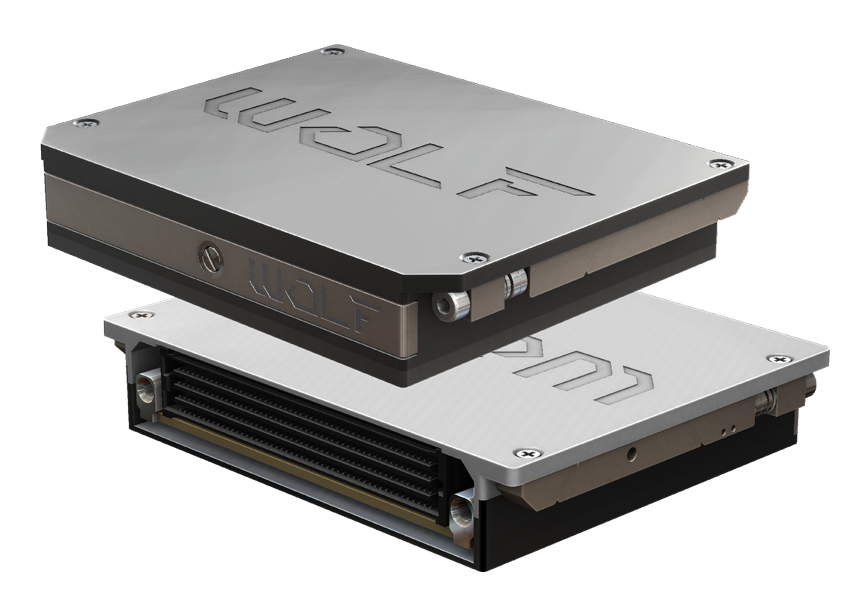
VNX+ 4K Video Capture and Conversion with FGX2
The VNXP-FGX2-VIO provides a high data rate, high density video capture and transmit platform with the FGX2, WOLF’s second-generation frame grabbing technology. FGX2 is a 4K-capable digital and analog frame grabber with conversion and transmit capability, built on the Xilinx® Kintex® UltraScale+™ series of FPGA devices. It is ideally suited for machine vision, synthetic vision or video processing applications deployed in harsh environments where SWaP (Size, Weight and Power) is at a premium.
This module can be paired with a WOLF NVIDIA powered SBC or GPU module to provide extremely low latency peer-to-peer communication which will reduce CPU overhead when processing or encoding large amounts of data.
MCOTS options include the ability to change interfaces to other analog or digital video standards. RTOS drivers are optionally available upon request.
Features
WOLF-N180 is a compact VNX+ rugged video capture and transmit module that integrates WOLF’s Frame Grabber eXtreme 2 (FGX2) to support high data rate, high-density video ingest, conversion, and distribution in SWaP-constrained environments. FGX2 is a 4K-capable digital and analog frame grabber with conversion and transmit capability built on Xilinx Kintex UltraScale+ FPGA devices, and the module supports up to two 12G-SDI or up to four 6G/3G/HD-SDI SerDes inputs and outputs. The design is intended to pair with an NVIDIA-powered SBC or GPU module for extremely low-latency peer-to-peer workflows, with module power configurable from 12W to 25W depending on options.
FGX2 Features
- Integrated WOLF Frame Grabber eXtreme 2 (FGX2)
- 4K-capable digital frame grabbing, conversion, and transmit capability
- Up to two 12G-SDI or up to four 6G/3G/HD-SDI SerDes inputs and outputs
- Optional DDR4 memory for additional application support
- Low-latency peer-to-peer communication with NVIDIA-powered GPU and SBC modules
- Module power configurable from 12W to 25W, depending on options
Connectivity / System Management
- PCIe Gen3 x4 host interface
- Linux and Windows drivers
- Optional VxWorks RTOS drivers
- I²C, debug UART, GPIO, and other module I/O
- Extended product lifespan
- MCOTS interface options available for additional analog and digital video standards
Mechanical / Open Systems Architecture
- Rugged conduction-cooled VNX+ module
- Operating temperature: -40°C to +85°C
- Vibration, sine wave: 10G peak, 5Hz to 2000Hz
- Shock: 40G peak
- Dimensions:
- 101.6mm x 78.1mm x 19mm with PIM retainers
- 89mm x 78.1mm x 19mm without PIM retainers
- Approximate weight: 280g
- ANSI/VITA 90
Specifications
Key configuration and performance parameters for WOLF-N180 are summarized below for quick comparison. Values shown reflect the standard module configuration; contact WOLF if you need a tailored build or a specific payload profile.
Configuration Guide
The following table defines a series of common order codes for the VNXP-FGX2-VIO module. The asterisks denote characters of the part number that are defined based on common configuration options.
Some configuration options for this module include:
- Analog config options
- Conformal coatings
Contact Sales for the latest Ordering Numbers and available options.
Representative Ordering Numbers
| Ordering Number | Description |
|---|---|
| N18033-F***-***VNXPvA0 | VNX+ FGX2 module with 12G-SDI, 2 inputs and 2 outputs |
| N18033-F***-***VNXPvA0 | VNX+ FGX2 module with ARINC 818, 3840x2160p60, 16-bit YCbCr, 2 inputs and 2 outputs |
| N18033-F***-***VNXPvA0 | VNX+ FGX2 module with 6G-SDI, 4 inputs and 4 outputs |
Related Products
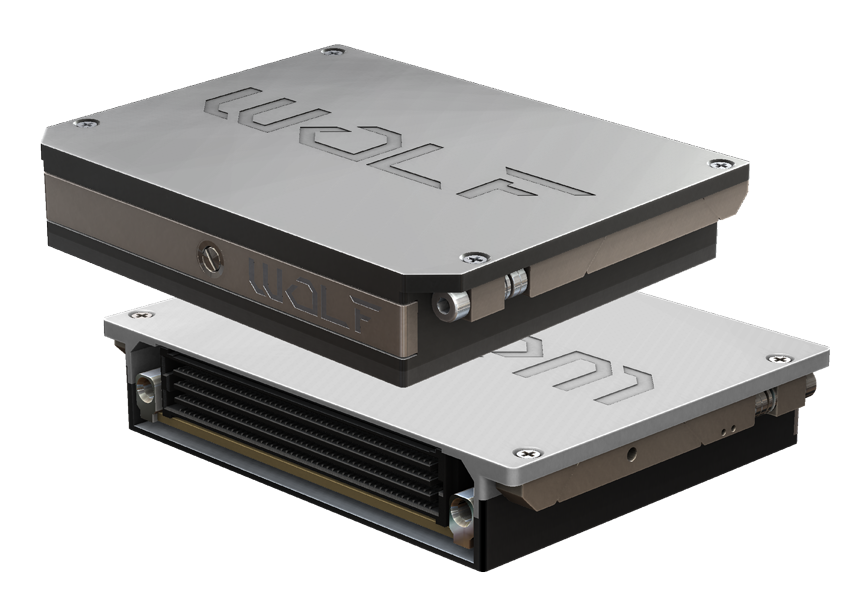
- NVIDIA Jetson Orin NX 16GB (Ampere)
- 1024 CUDA Cores, 32 Tensor Cores
- 16 GB LPDDR5 VRAM
- PCIe Gen 4 x4
- N/A
- Module power 20–35 W
FAQ
Choose WOLF-N180 when you need high-density, low-latency video capture and conversion in a VNX+ SWaP envelope, and you plan to pair it with a compute node (such as an NVIDIA-powered SBC/GPU module) for processing or encoding.
This module is typically selected for:
- Sensor ingest nodes where minimizing size and power (12W–25W) is critical
- Architectures that want video I/O as a modular “sidecar” to a compute node
- Systems that prioritize peer-to-peer low-latency workflows to reduce CPU overhead
If your design already standardizes on VPX slots and you have enough room/power, a VPX or XMC capture module can provide more I/O and carrier flexibility.
It is intended to support low-latency data exchange with an NVIDIA GPU so that video can be moved into the compute pipeline with reduced host CPU involvement.
This is most relevant when:
- You are streaming high-rate video and CPU copies become a bottleneck
- You need deterministic latency for real-time vision/video processing
- You are pairing this module with an NVIDIA compute node and want a tightly coupled ingest-to-processing path
Net: GPUDirect-style capabilities tend to matter more at the system level than at the single-module level—plan the paired compute topology early.
Confirm early:
- I/O configuration: supports up to 2× 12G-SDI or up to 4× 6G/3G/HD-SDI inputs and outputs (configuration dependent). Decide early which mode your system needs.
- Analog options: some configurations support analog variants (e.g., CVBS input or output options). Lock this early because it affects wiring and carrier breakout.
- PCIe interface: PCIe Gen3 x4—validate bandwidth sufficiency against your channel configuration and streaming strategy.
- Software baseline: Linux/Windows drivers are referenced; standalone embedded Linux operation is also supported; VxWorks RTOS drivers are optional.
For FGX2-class modules, the two most common pitfalls are underestimating PCIe bandwidth needs and leaving the I/O configuration undecided until late.
Key ordering-time decisions typically include:
- I/O mix: 12G-SDI vs 6G/3G/HD-SDI channel mapping and directionality
- Analog configuration options (CVBS input vs output variants)
- DDR4 option: optional onboard DDR4 referenced for additional application support
- RTOS drivers: VxWorks option if required
- Conformal coating and variant control
- Power threshold (12W–25W): align to chassis thermal headroom and sustained operation expectations
Contact Sales for the latest ordering numbers and available options.