
Across Europe, defence priorities are changing fast.
What was once a long-term modernization effort has become an urgent push toward faster deployment, greater operational readiness, and stronger technological independence. Governments across Europe are increasing defence spending while investing heavily in AI, autonomous systems, ISR, drone-technology, and next-generation battlefield technologies.[i]
But increasing capability is only part of the challenge. Modern defence systems are expected to process more data, react faster, and operate in increasingly constrained environments — whether mounted on unmanned systems, deployed in tactical vehicles, or integrated into airborne platforms.
That shift is putting new pressure on embedded computing at the edge.
Why Edge Processing Matters More Than Ever
Today’s defence platforms produce vast amounts of sensor and video data. In many operational environments, transmitting all of it to centralized infrastructure is impractical.
Latency, bandwidth limitations, contested communications environments, and operational security concerns all push compute closer to the edge.[ii]
That means embedded systems now need to deliver:
- Real-time AI inference and sensor processing directly on-platform, without relying on external connectivity
- High-performance compute in compact, ruggedized systems that can survive harsh aerospace and defence environments
- Low-latency video and ISR processing to support faster tactical decision-making
The challenge is not just delivering more compute. It is delivering the right compute within strict SWaP-C constraints.
The Push Toward Smaller, Smarter, More Modular Systems
Across Europe, defence programs are also moving toward more modular and open architectures.[iii]
Instead of building rigid, closed systems that are difficult to upgrade, organizations are prioritizing platforms that can evolve as mission requirements change. Standards like VPX and SOSA are becoming increasingly important because they allow systems to integrate faster, scale more easily, and reduce long-term integration risk.
As missions continue to push compute closer to the edge, the industry is also embracing smaller form factors that preserve performance while reducing size, weight, and power. VNX+ is emerging as one such approach. Developed to deliver high-performance embedded computing in an ultra-compact footprint, the VNX+ standard enables engineers to integrate AI processing, video, networking, and sensor capabilities into platforms where traditional VPX systems may be impractical. This makes it well suited for autonomous systems, tactical vehicles, airborne platforms, and other SWaP-C-constrained applications where every cubic inch matters.
That balance between performance, modularity, and compact design is becoming one of the defining engineering challenges in modern defence systems.
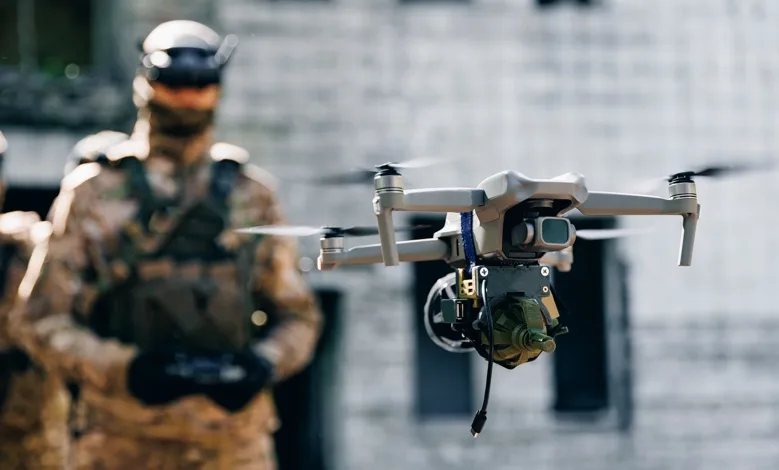
Small applications like drones require smaller modules that can perform large capabilities
The WOLF Perspective
At WOLF, we see this shift firsthand.
As defence and aerospace platforms become more autonomous and data intensive, customers increasingly require embedded computing solutions that combine high-performance AI processing with the flexibility to deploy in highly constrained environments. WOLF’s VNX+ ecosystem was developed to address these evolving requirements, providing rugged, modular computing solutions that enable advanced processing at the tactical edge without sacrificing SWaP-C objectives.
At Eurosatory 2026, WOLF demonstrated how VNX+ can bring advanced AI capabilities to the tactical edge through its compact, deployment-ready single-slot VNX+ system. Purpose-built for space-constrained aerospace and defence applications, the rugged system integrates WOLF’s NX-powered single-board computer (SBC) module with onboard power conversion in a streamlined chassis designed for immediate deployment.
The demonstration highlighted how AI inference, machine vision, real-time video processing, and sensor analytics can be performed directly at the edge within an exceptionally compact footprint. The system also incorporates a 1 TB self-encrypting NVMe drive (SED), providing hardware-level data protection for mission-critical applications.
The demonstration reflected the broader evolution of the VNX+ standard. Building upon the VITA 74 VNX specification, VNX+ extends the capabilities of small form-factor embedded computing by supporting higher power delivery and advanced connector technologies, enabling increasingly sophisticated workloads while maintaining the compact footprint required by modern aerospace and defence platforms.
Looking Ahead
Europe’s defence transformation is creating demand for systems that are faster, more adaptable, and easier to deploy across a wide range of missions and environments.
Meeting that demand will require more than incremental performance improvements. It will require embedded computing architectures that combine AI readiness, open standards, ruggedization, and compact design to support evolving mission requirements.
As VNX+ adoption continues to grow, WOLF remains focused on advancing modular edge computing solutions that help customers accelerate integration, optimize SWaP-C, and deploy next-generation capabilities with confidence.
About Wolf Advanced Technology
Wolf Advanced Technology (WOLF) delivers rugged, high-performance embedded computing, AI, and video processing solutions for aerospace and defense. Leveraging NVIDIA® GPUs and AMD®/Xilinx® FPGAs, WOLF delivers SWaP-optimized SOSA® aligned VPX, XMC, MXM/MXC, VNX+, SFF, and custom solutions, enabling real-time video, AI inference, and high-speed data in mission-critical environments.
[i] NATO, Defence Expenditure of NATO Countries (2014–2025), 2025; Council of the European Union, Defence Data 2024–2025.
[ii] RAND Europe, Distributed and Edge Computing in Defence Applications, 2024; NATO Review, Artificial Intelligence in Defence and Security, 2024.
[iii] SOSA Consortium, Sensor Open Systems Architecture Technical Standard, 2025; VITA Standards Organization, VPX and OpenVPX Systems for Embedded Computing, 2024.
[iv] Eurosatory 2026 Official Event Information, https://www.eurosatory.com/en/